Friday, November 6, 2015

Fun Fact - November 2015

Back on September 8, we celebrated the Nativity (birth) of the Virgin Mary. And this month, on November 21, we celebrate the fulfillment of the vow her parents, the “Holy and Righteous Ancestors of God, Joachim and Anna,” made in asking God to give them a child in their old age and in their barrenness. They had promised that, if God would give them this gift, this blessing, they would dedicate their child to His service.

This is from the ancient account of Mary’s early life, the “Protoevangelium of James”:

And the child was two years old, and Joachim said: “Let us take her up to the temple of the Lord, that we may pay the vow that we have vowed, lest perchance the Lord send to us [i.e., warn us of taking too long to fulfill our vow], and our offering be not received.” And Anna said: “Let us wait for the third year, in order that the child may not seek for father or mother.” And Joachim said: “So let us wait.”

And the child was three years old, and Joachim said: “Invite the daughters of the Hebrews that are undefiled, and let them take each a lamp, and let them stand with the lamps burning, that the child may not turn back, and her heart be captivated from the temple of the Lord.”


And they did so until they went up into the temple of the Lord. And the priest received her, and kissed her, and blessed her, saying: “The Lord has magnified thy name in all generations. In thee, on the last of the days, the Lord will manifest His redemption to the sons of Israel.”

And he set her down upon the third step of the altar, and the Lord God sent grace upon her; and she danced with her feet, and all the house of Israel loved her. And her parents went down marveling, and praising the Lord God, because the child had not turned back. And Mary was in the temple of the Lord as if she were a dove that dwelt there, and she received food from the hand of an angel.


So each year on November 21, we celebrate the Great Feast of the Entry of the Most Holy Theotokos into the Temple, just as the church has celebrated this feast from ancient times.

Sunday, September 20, 2015

Fun Fact - October 2015

I had the blessing and the pleasure, this past August, of making my fourth trip to Greece – spending time on the Holy Mountain (Mt. Athos) and with the wonderful nuns at Ormylia, and visiting the city of Thessalonica, whose Christian community dates back to the apostolic age, as we know from the two epistles of St. Paul addressed to the Thessalonians. Thessalonica has produced many saints over the centuries, and is adorned with dozens of ancient and beautiful churches. If you are able to visit Thessalonica, if you have time for nothing else, you must visit the Church of St. Demetrius, on the site where he was martyred on October 26, 306.

St. Demetrius succeeded his noble father as the Roman proconsul (provincial governor) of Thessalonica, charged by the Emperor Maximian with defending the city from barbarian attacks, and exterminating the Christian population. Little did Maximian know that he had appointed a faithful Christian to this important position, one who would protect and nurture the Christians of the city rather than persecute them.

When he discovered his error, Maximian had Demetrius arrested, and imprisoned him in a bathhouse. At the same time, he put on “games” in which his champion, the barbarian wrestler Lyaeus, would fight with helpless Christians, throwing them out of the ring and to their deaths. From his prison cell, Demetrius blessed his servant Nestor to challenge Lyaeus, and shouting “O God of Demetrius, help me!,” Nestor slew the emperor’s champion.


In a furious rage, Maximian sent soldiers to kill Demetrius in the bathhouse, running him through with spears.


The Church of St. Demetrius is built over the site of the bathhouse, which you can visit in the crypt of the church. The saint’s relics are in the nave of the church, in a beautiful silver reliquary. They exude a sweet-smelling myrrh, for which St. Demetrius is called “The Myrrhstreaming” – and each year on his feast day, October 26, his relics are uncovered and cotton balls soaked in the myrrh and given out to pilgrims as a great blessing. I have one of these, and I can say that the scent is truly heavenly.


Holy Saints Demetrius and Nestor, pray to God for us!

Fun Fact - September 2015

The month of August brought the church year to an exciting close, with two great feasts – the Transfiguration of the Lord on August 6 and the Dormition of the Theotokos on the 15th – plus a major fast for the Dormition from August 1-14 and a strict fast day for the Beheading of St. John the Baptist on the 29th. September starts the new church year off with a bang: two more great feasts – the Nativity of the Theotokos on September 8 and the Elevation of the Holy Cross on the 14th – and a strict fast day for the Cross.

A few words on the Nativity of the Theotokos… Like the devoted, God-fearing couples we meet in the Old Testament, Saints Joachim and Anna were elderly and barren, unable to have children. Their offering at the temple in Jerusalem rejected on this account (the priests assumed their barrenness was due to some hidden sin), Joachim was grief-stricken, as was Anna. But God attended to their prayers, and the Archangel Gabriel brought them the news that Anna, even in her deep old age, would bear a child – Mary, who would become the Theotokos (“the Bearer of God”). It is for this reason that we commemorate Joachim and Anna as “the holy and righteous Ancestors of God.” We celebrate Mary’s conception from St. Anna on December 9, and her birth (or nativity) on September 8, almost exactly 9 months later.

And regarding the Elevation of the Holy Cross… After the Romans overran Jerusalem in 70 AD, the Roman Emperors sought to bury (literally) all evidence of the life and death and resurrection of Jesus. The sites of Golgotha, where He was crucified, and the Holy Sepulcher, where He was buried, were covered over, and a pagan temple erected in their place. Some 250 years later, after St. Constantine had become Emperor, achieving his great victories under the banner of the Cross, he sent his mother, St. Helena, to work with St. Macarius, the Patriarch of Jerusalem, to find the Lord’s Cross. They were successful, and in the year 326, the Patriarch elevated the Holy Cross for all to see and venerate as they cried out “Lord, have mercy!” We celebrate this feast – which is also a strict day of fasting – each year on September 14. From this comes our custom of elevating the Cross to all the points of the compass while singing “Gospodi Pomilui” a total of 500 times. Why we sing “Gospodi Pomilui,” which is “Lord, have mercy!” in Old Church Slavonic… is a story for another time!

Fun Fact - August 2015

The summer is racing by. How can it be August already? Well, the days may be getting shorter, but there’s no shortage of light and life on the church front!

August 1 marks the beginning of the Dormition Fast, which runs until the Great Feast of the Dormition (or Falling Asleep) of the Mother of God on August 15. This fast is kept very strictly – second only to the fasts of Great Lent and Holy Week. But it is not a dark fast, or a dark period in the life of the Church. It is anything but! This is shown most magnificently in one of the hymns sung at Great Vespers for the feast – a hymn which stands out in that each line is chanted in a different tone:

By the divine command, the God-bearing Apostles were caught up by clouds from every place. When they came to your all-pure body, the source of Life, they kissed it most reverently. The highest Powers of heaven were also present with their Master, and seized with awe, they escorted the inviolate body, the body that had received God in the flesh. In a manner beyond this world, they went before it and invisibly cried out to the ranks above them: “Behold, the Queen of all and Child of God has come! Lift up your gates, and in a manner beyond this world receive the Mother of the ever-lasting Light, for through her was accomplished the salvation of all the mortal race! We cannot gaze upon her, nor is it possible to render honor worthy of her, for her excellence surpasses all understanding.” Therefore, immaculate Theotokos, who live forever with your Son, the life-bearing King, pray ceaselessly to Him to preserve the new people of God, and to save them from every hostile assault, for we have acquired your intercession, and to the ages, in manifest splendor, we call you blessed.”

We don’t fast out of sadness or mourning – but out of reverence and great wonder, recognizing that “we cannot gaze upon her, nor is it possible to render honor worthy of her, for her excellence surpasses all understanding.”

In addition to the Fast and Feast of the Dormition, August is marked by the Great Feast of the Transfiguration on August 6, which is precisely 40 days before – and thus connected to – the Great Feast of the Elevation of the Cross on September 14. We commemorate the Beheading of St. John the Baptist on August 29, a strict fast day on whatever day of the week it falls. And August 31 marks the last day of the church year, which begins anew on September 1. But that is a story for next month!

Wednesday, June 17, 2015

Fun Fact - July 2015

Last month, we talked about the busy start to our summer, with the Feasts of the Ascension and Pentecost coming late in May, followed by the Sunday of All Saints and the Apostles’ Fast in June. While there are no Great Feasts or extended fasts in July – we do keep the traditional fasts on Wednesday and Friday throughout the month – there are a number of especially noteworthy feast days gracing our calendars.

July 1 marks the feast of the Holy Unmercenary Physicians Cosmas and Damian of Rome, so called because they “treated the infirm by the power of our Lord Jesus Christ and took no payment for rendering aid to the sick,” and we continue with celebrations for St. John of San Francisco (July 2), St. Andrew of Crete (July 4), St. Vladimir of Kiev (July 15), the New Martyr Elizabeth of Russia (July 18), St. Seraphim of Sarov (July 19), the Prophets Elias (July 20) and Ezekiel (July 21), St. Mary Magdalene (July 22), St. Anna (July 25), St. Panteleimon (July 27) and St. Joseph of Arimathea (July 31), among many others. Let’s talk about one “hometown hero” you may be less familiar with.

St. Joseph of Damascus (July 10) was the priest of the Patriarchal Cathedral of the Dormition of the Most Holy Theotokos (al-Mariamiyeh) in Damascus. On July 9th, 1860 the brutal massacre of Christians, which began in the mountains of Lebanon, spread to Damascus. Some Damascenes (including Michael Hawaweeny and his wife Mariam, who was pregnant with their son, the future St. Raphael of Brooklyn) fled Damascus for the city of Beirut. Most, however, took refuge in al Mariamiyeh. St. Joseph took up his communion kit and began to make his way to the Cathedral by jumping from rooftop to rooftop across the narrow streets of the Old City. As he went, he stopped to confess and commune the aged and infirm who could not flee their homes, encouraging them with stories from the Lives of the Great Martyrs. On the morning of July 10th, the Cathedral was surrounded and burned by a fanatical crowd. Those inside perished in the flames; of those who escaped and fled into the streets, most were shot or caught and forced back into the burning building, while only a few, including St. Joseph, survived. As he roamed the narrow streets searching for survivors, he was apprehended and brutally killed. St. Joseph's sacred relics were then pitched into the city dump along with those of the other New Martyrs, numbering 2,500 men plus women and children. St. Joseph and his companions were glorified by the Holy Synod of Antioch in 1993. (Adapted from antiochian.org)

Through their intercessions, Lord Jesus Christ our God, have mercy upon us! Amen.

Tuesday, May 19, 2015

Fun Fact - June 2015

I’m writing this just a few days after the graduation ceremonies for our church school, and looking forward, with all the kids, to a long summer off… NOT!! Are you kidding? We have a lot to do this summer, as we head into the final stretch of the church year.

Five weeks and four days after Pascha (May 20, this year), we celebrate the Leavetaking of Pascha – saying our farewells to the feast and singing our final “Christ is Risen!” for the year. But on the very next day, the 40th after the resurrection (May 21), we celebrate the Feast of the Ascension, remembering that after He rose from the dead, Jesus “ascended into heaven, and sits at the right hand of the Father; and He shall come again with glory to judge the living and the dead; whose Kingdom shall have no end.

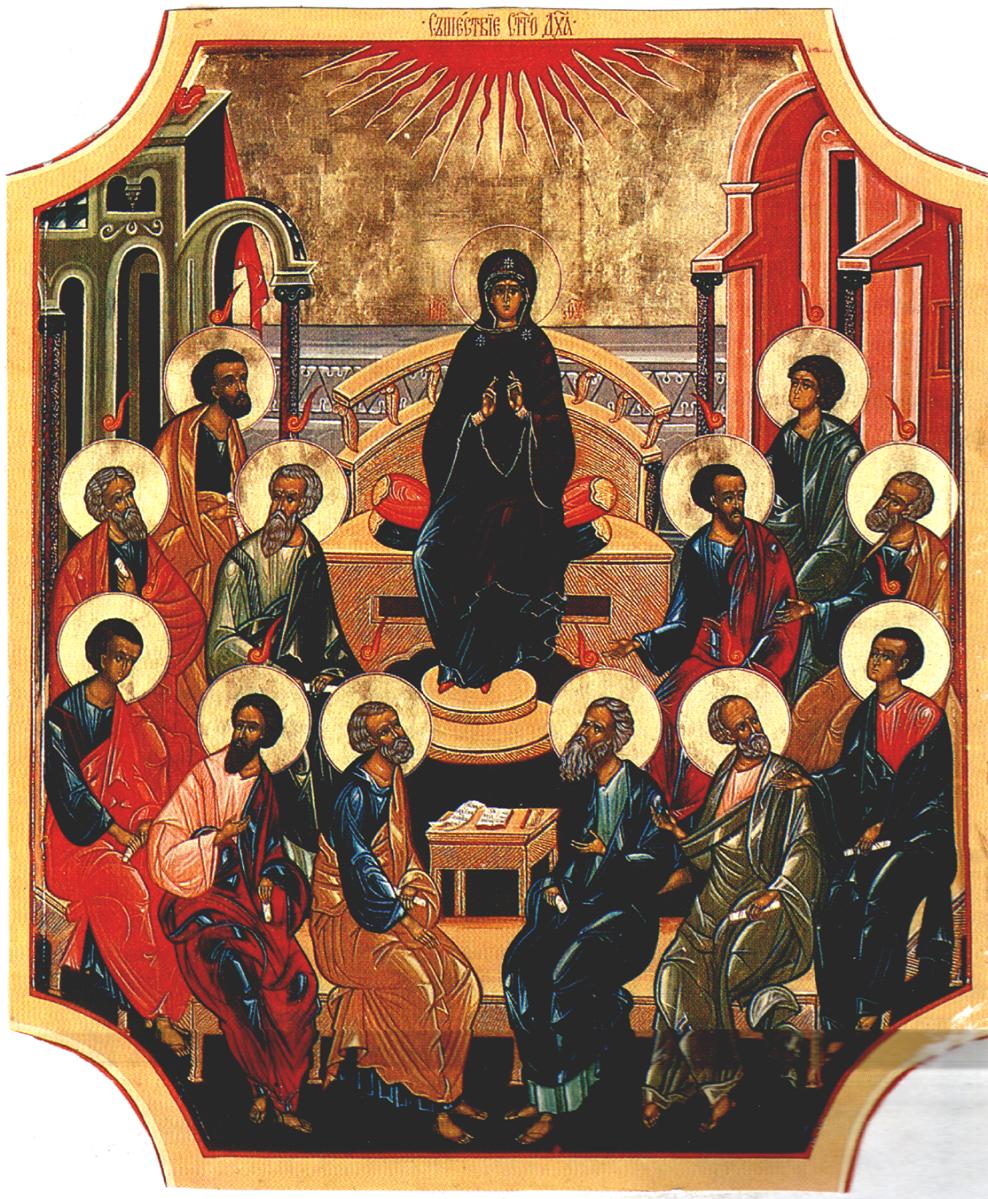
On the 50th day, Pentecost Sunday (May 30), we celebrate the pouring out of the Holy Spirit on the church. We resume the singing of “O Heavenly King” during Vespers the evening before, and at Vespers on the day of Pentecost itself, we read the beautiful and moving “Kneeling Prayers.” The following Monday (June 1) is dedicated to “the Holy Spirit, the Lord, the Giver of Life, who proceeds from the Father; who with the Father and the Son together is worshipped and glorified; who spoke by the prophets.” The dates of Ascension and Pentecost vary each year, as they are based on the date of Pascha, but they generally fall in late May or early June.

All Saints Day is the Sunday after Pentecost (June 7), and is an extension of feast – as we remember all those who, nourished by the Holy Spirit, grew up and bore fruit in the garden of the church. The Monday after All Saints (June 8) marks the beginning of the Apostles’ Fast, which ends with the Feast of the Holy Apostles Peter and Paul on June 29. When Pascha and the feasts connected to it come early, the fast is long. When Pascha comes very late, the fast can vanish entirely, ending before it begins! (But only on the New Calendar. On the Old Calendar, it’s always 13 days longer!) June ends with the Synaxis (gathering-in-honor) of the Holy Apostles on June 30… marking the end of the first of three very busy, very joyful months in the life of the church. I’ll tell you more about July next time – but as a hint, it’s all about the saints!

Friday, July 4, 2008

Getting Better With Age

I had the joy of seeing Fr. Thomas Hopko, my father confessor from my seminary days (and one of the two priests who, with Fr. Paul Lazor, married Marta and me), a couple of weeks ago, speaking to high school students who were participating in the (spectacular) CrossRoad program at Hellenic College, under the direction of my friends Ann Bezzerides and Dn. Nick Belcher.

The content of his talk echoed what I had posted at the end of May, under the caption How Can I Know? But much of it also echoed the remarks he made at St. Vladimir's Seminary in his 2007 Commencement Address.

Re-reading those remarks today, I find that they -- as well as he -- just get better with age. I hope you find them as meaningful as I did and do.


Commencement Address
Delivered by the Very Rev Thomas Hopko, Dean Emeritus of St. Vladimir's Seminary, on May 19, 2007

Your Beatitude Metropolitan Herman. [Your Eminence…. Your Grace ….]

Father Dean Erickson, fathers, mothers, sisters, brothers, and most especially the honored members of the Class of 2007: Glory to Jesus Christ!

I am delighted to speak to you at this commencement ceremony today. This honor is especially significant for me since I came to this school as a student exactly a half century ago, in September 1957.

For forty of the last fifty years I was officially connected with St. Vladimir’s. I was a student for six years, and, after five years as a pastor in Ohio, I returned to the seminary where I served as a teacher and pastor for thirty-four years until my retirement five years ago. This school gave me my spiritual life and my spiritual family. It also gave me my wife, and our children and grandchildren, for which I am inexpressibly grateful.

Father Erickson and the seminary faculty asked me to tell you today what I believe to be the most important things that I learned in the last fifty years. They asked me to do this in about twenty minutes. So what can I tell you in my remaining nineteen?

The first and most important thing is that we are boundlessly loved by God who blesses us to love Him boundlessly in return.

I can also tell you that we can love God as He loves us only by faith and grace, by His own divine power, and that we prove our love for Him by loving everyone and everything, beginning with our worst enemies, just as He does, with the very same love with which He loves us, the very Love that He Himself is.

And I can tell you that being loved by God, and loving Him in return, is the greatest joy given to creatures, and that without it there is no real and lasting happiness for humanity.

And I can also tell you, alas, that such loving is always a violent, brutal and bloody affair.

The God who is merciful and gracious, longsuffering, and abounding in steadfast love and faithfulness, who gives us his divine life and peace and joy forever, is first of all the Divine Lover who wounds His beloved, and then hides from her, hoping to be sought and found. He is the Father who chastens and disciplines His children. He is the Vinekeeper who cuts and prunes His vines so that they bear much fruit. He is the Jeweler who burns His gold in His divine fire so that it would be purged of all impurities. And He is the Potter who continually smashes and refashions and re-bakes His muddy clay so that it can be the earthen vessel that He wants it to be, capable of bearing His own transcendent grace and power and glory and peace.

I learned that all of these terrible teachings of the Holy Scriptures and the saints are real and true. And so I became convinced that God’s Gospel in His Son Jesus is really and truly God’s final act on earth. It is the act in which God’s Word is now not simply inscribed in letters on pages of parchment, but is personally incarnate as a human being in his own human body and blood. And so I became convinced of the truth of all truths: that the ultimate revelation of God as Love and the ultimate revelation of humanity’s love for God, are to be found in the bloody corpse of a dead Jew, hanging on a cross between two criminals, outside the walls of Jerusalem, executed at the hands of Gentiles, by the instigation of his own people’s leaders, in the most painful, cursed, shameful and wretched death that a human being -- and especially a Jew – can possibly die.

So to the measure that we are honest and faithful, and try to keep God’s commandments, and repent for our failures and sins, we come to know, and to know ever more clearly and deeply as time goes by, what we have learned here at St. Vladimir’s. We come to know by experience that the Word of God (ho logos tou theou) is always and necessarily the word of the Cross (ho logos tou stavrou). And -- in language befitting a commencement ceremony at an Orthodox graduate school of theology -- we come to see that true theologia is always stavrologia. And real orthodoxia is always paradoxia. And that there is no theosis without kenosis.

Theology is stavrology and Orthodoxy is paradoxy: the almighty God reveals Himself as an infinitely humble, totally self-emptying and absolutely ruthless and relentless lover of sinners. And men and women made in His image and likeness must be the same. Thus we come to see that as there is no resurrection without crucifixion, there is also no sanctification without suffering, no glorification without humiliation; no deification without degradation; and no life without death. We learn, in a word, the truth of the early Christian hymn recorded in Holy Scripture:

If we have died with him, we shall also live with him;
if we endure with him, we shall also reign with him;
if we deny him, he will also deny us;
if we are faithless, he remains faithful – for he cannot deny himself. (2Tim 2.11-13)

According to the Gospel, therefore, those who wish to be wise are constrained to be fools. Those who would be great become small. Those who would be first put themselves last. Those who rule, serve as slaves. Those who would be rich make themselves poor. Those who want to be strong become weak. And those who long to find and fulfill themselves as persons deny and empty themselves for the sake of the Gospel. And, finally, and most important of all, those who want really to live have really to die. They voluntarily die, in truth and in love, to everyone and everything that is not God and of God.

And so, once again, if we have learned anything at all in our theological education, spiritual formation and pastoral service, we have learned to beware, and to be wary, of all contentment, consolation and comfort before our co-crucifixion in love with Christ. We have learned that though we can know about God through formal theological education, we can only come to know God by taking up our daily crosses with patient endurance in love with Jesus. And we can only do this by faith and grace through the Holy Spirit’s abiding power.

When we speak about “taking up our crosses” and “bearing our burdens” in imitation of Christ, by the power of God’s Holy Spirit, we also learn by painful experience that the crosses we take up and the burdens we bear must be those that God gives us, and not those that we ourselves choose and desire. Thus we become convinced that when our burdens are unbearable and our crosses crush us in joyless misery -- and we become dark, depressed, despondent and desperate -- the reasons are evident. Either we are choosing our own crosses and burdens, and rejecting those sent to us by our merciful God whose thoughts and ways are not ours; or we are attempting to carry our crosses and bear our burdens by our own powers, and not by God’s grace and strength given to us by Christ and the Holy Spirit in the Church.

And so we come to another conviction: The Church, the communion of faith and love (as St. Ignatius of Antioch defined it: henosis agapis kai pisteos), the community of saints who are Christ’s own very “members” as his body and bride, is essential to our human being and life. We cannot be human beings – still less, Christians and saints – by ourselves. We need God and his wise and faithful servants. We need God’s commandments and living examples of their fulfillment. We need the Church’s scriptures, sacraments, services and saints. And we need one another. As Tertullian said centuries ago, “One Christian is no Christian.” And as the Russian proverb puts it, “The only thing that a person can do alone is perish.” Like it or not, we are “members of one another” in God. If we like it, it is life and paradise. If we reject it, it is death and hell.

So, in the end, because everything is about the true God and Christ and the Holy Spirit, and the Church’s scriptures, sacraments, services and saints, and God’s love, wisdom, truth and power, so too, therefore, is everything about the most important and Godlike reality of all, what St. John Climakos called “thrice-holy humility”: the humility of God himself that cannot be defined but can only be seen and adored in the crucified Christ, and in those who, by faith and grace, are co-crucified with Him.

Thus, if we have become convinced of anything at all as Orthodox Christians, we are convinced that human beings are not autonomous. The proclamation and defense of human autonomy is the most insidious lie of our day, especially here in North America, and in the Western and Westernized worlds generally. Humans beings are by nature heteronomous. Another law (heteros nomos) is always working in our minds and members. This “other law” is either the law of God, the law of Christ, the law of the Holy Spirit, the law of liberty and life that can only be recognized, received and realized by holy humility, or it is the law of sin and death. (cf. Romans 7-8) When the law within us is God’s law, then we are who we really are, and we are sane and free. But when that law is the law of sin and death, then we are not ourselves, and we are insane, enslaved and sold to sin.

More than fifteen hundred years ago St. Anthony the Great declared that “a time is coming when people will go mad, and when they see someone who is not mad, they will attack him saying, ‘You are mad, you are not like us.” (Saying 25)

It may well be that the time that St. Anthony foresaw is now upon us, or at least is rapidly approaching, at least in the West. And because of what we have learned, we know what we have to do about it. The same St Anthony, with all holy people, has told us. I urge you, and, if I could, I would command you, to read St. Anthony’s thirty-eight sayings in the Sayings of the Desert Fathers. Everything we need to know in order to live is there for us in its simplest and clearest form.

Abba Anthony first tells us that when we are plagued by whirling thoughts (logismoi) and worn down by an overwhelming sense of meaninglessness and futility (akedia), which we will be in this sinful world, we must simply and diligently work and pray, by pure devotion and sheer obedience. We must pay attention to ourselves and mind our own business. We must do our work, and let God -- and other people -- do theirs.

He also tells us that whoever we are, we should always have God before our eyes; and whatever we do, we should always do according to the testimony of the Holy Scriptures; and wherever we are, we should not easily leave that place.

He further tells us (with his friend Abba Pambo) not to trust in our own righteousness, not to worry about the past, and to guard our mouths and our stomachs. He tells us to take responsibility for our own behavior, and to expect to be ferociously tempted to our very last breath. He tells us that there is no salvation for us without trial and temptation, and that without being tested, no person can be healed, illumined and perfected. He tells us that each one of us has our own unique life, that no two people are the same, and that each of us has to be the person that God made us to be (as Fr Paul Lazor, my dearest friend, so often says): where we are, when we are, with whom we are, from whom we are, and such as we are, according to God’s inscrutable providence.

Anthony also tells us, as do all the saints, that our life and our death begin and end with our fellow human beings. He insists that if we have gained our neighbor, we have gained our God, but if we have scandalized our neighbor, we have sinned against Christ. He says that all of our ascetical disciplines, including our scholarly studies, are means to an end; they are not ends in themselves. The end is discernment (diakrisis) and dispassion (apatheia) and the knowledge (epignosis) of God through keeping His commandments, the first and greatest of which is love. And he teaches that our only hope to escape the countless snares of this world that seek to enslave us is found in one thing alone: Christ-like humility, with “a broken, contrite and humble heart,” as the psalmist says, being our sole “sacrifice acceptable to God.” (Psalm 51.17)

“ I saw all the snares the enemy spreads out over all the world” Abba Anthony said, “and I cried out groaning, ‘What can get through from such snares?’ Then I heard a voice saying to me, ‘Humility’.” (Saying 7)

An extended explanation of St. Anthony’s teachings, and those of our Christian saints generally, may be found in a book published in 1867 in Russia. It is by St. Ignaty Brianchaninoff, and is called in English The Arena: An Offering to Contemporary Monasticism. I am convinced that every committed Christian, surely every seminary graduate, should feel obliged to read this book, meditating especially on its first part about the absolute necessity of keeping God’s evangelical commandments (evangelskii zapovedy), accompanied by St Ignaty’s dire warnings to religious people -- especially those with theological educations and ascetical inclinations and mystical desires-- who may fail to keep the commandments of the Gospel because they accept the lie that they are “not like other people” as they surrender to the delusion -- the fiercest and most destructive of all delusions for religious people -- that they are especially gifted, zealous and illumined. For, as my beloved Professor Serge Verhovskoy never tired of warning: “The worst of all sins is the lie, and the worst of all lies is the lie about God, and worst of all lies about God is the lie about God and me.”

I would also recommend today, and, again, if I could, I would also insist that all thinking Christians, and surely all seminary students and graduates, be required to read one other book that contains, in my view, the most incisive analysis of what has happened to humanity in the last fifty years. It is C. S. Lewis’s prophetic masterpiece written in 1944 called The Abolition of Man. This slender volume should be read slowly, methodically and carefully many times over. Parts of it, which I have read more than ten times, are still unclear to me. But its main point is crystal clear.

Lewis says that for human beings to see, know, love, adore and offer fitting thanksgiving for all that is good, true and beautiful in human life, and so to remain fully and truly human, they must possess and cultivate the uniquely human faculty that differentiates them from angels and beasts, and, we must also add today, from the artificial intelligence of electronic technology. Lewis calls this faculty the “Tao.” He says that it may also be called the “image of God” or the “spark of divinity” or the Law or the Logos or the Heart. (Today, if he knew Orthodox literature, he might have also said that it may be called the Nous.) Whatever one calls it, it is the faculty whereby human beings intuit and contemplate the basic truths of human being and life that ground all ratiocination, discourse and disputation. Lewis claimed in 1944 that if the methods of education prevailing in the schools of his day prove to be successful, this uniquely human faculty will be obliterated, and human beings as we have known them will no longer exist. It will literally be “the abolition of man.”

I am convinced that what Lewis foresaw has happened, and is still happening with ever more catastrophic consequences, in our Western and Westernized worlds. It happens that men and women who once were human are simply no longer so. They have become nothing but minds and matter, brains and bodies, computers and consumers, calculators and copulators, constructers and cloners who believe that they are free and powerful but who are in fact being destroyed by the very “Nature” that they wish to conquer as they are enslaved to an oligarchy of “Conditioners” who are themselves enslaved and destroyed by their insane strivings to define, design and manipulate a world and a humanity bereft of the God who boundlessly loves them.

Others have seen and said similar things to what C. S. Lewis saw and said: Fyodor Dostoevsky, Karl Stern, Alexander Solzhenitsyn, Thomas Merton, the alleged atheist Anton Chekhov, and my most beloved Flannery O’Connor are among my personal favorites.

The challenge and joy – and the pain and discomfort – of reading such extraordinarily gifted people as these, whom the members of the Class of 2007 have most likely not read for their courses at St. Vladimir’s (but who knows what the new curriculum will bring?), still lies before them. And this tells us why this present graduation ceremony is called a “commencement.” It is a beginning of new things -- many wonderful and challenging and convincing new things -- that we wish for the men and women completing their studies at St. Vladimir’s Seminary this day.

And this brings us to the last conviction that I may share with you today: Every day, by God’s grace, brings us a new beginning. We are all always “commencing” a new spiritual adventure in living and loving as God lives and loves. It is never over. And it is never too late to start anew.

I congratulate the Class of 2007 for their remarkable achievements. I congratulate their families, friends and teachers, and all who cared for them during their time at the seminary. I pray that the Merciful Lord will bless, guide and protect them in every way as they “commence” this new stage of their lives. And I thank God and the seminary faculty for the privilege and honor of addressing them, and you all, here today.

Saturday, May 31, 2008

How Can I Know?

HOW CAN I KNOW?
By Father Thomas Hopko

How can I know God as God really is?

How can I know Christ as the way, the truth, and the life of God, and humanity, the light of the world? How can I know the Orthodox Church as “the household of God,” and “the pillar, and bulwark of the truth” - God’s kingdom on earth? If you want to find answers for yourself to these questions, Orthodox Christian saints, and spiritual teachers would ask you to do the following things as faithfully, and honestly as you can, and to see for yourself what happens.

1. Be ready to do whatever it takes to know. Humbly, and courageously do what you are told without questioning it in any way. Be determined to follow what you come to know, whatever the cost.

2. Pray for enlightenment, even if your prayer is “to whom it may concern.” Pray something like this: “God, if you exist, reveal yourself to me.” If you already believe in God somehow, then pray: “God, reveal yourself to me as you really are.” As you pray, do not look for anything. Let whatever happens, happen.

3. While praying this way, read through the New Testament very slowly, at least three times. Take several months to do this. Do not be bothered about what you don’t understand, but try to put into practice what you do understand.

4. During this time, go to Orthodox Church services if you can. Just stand, or sit there, and listen. Do not judge the people who are there, in any way. Do not be bothered about what you don’t understand. If you are a confused, and troubled member of the Orthodox Church, do not serve at the altar, or read, or sing in the choir, during this period.

5. During this time, do not lie about anything, do not consciously harm anyone, try to be kind, and good to everyone you meet, without exception. If possible, do some good work for others, even if just for an hour or two a week, as secretly as possible. Also if possible, give away some money secretly to those in need.

6. During this time, if you are not married, do not engage in any sexual acts at all, of any kind, even with yourself alone. If you fail in this, forget it immediately, and start over.

7. During this time, do not get drunk. Do not eat too much. Do not eat unhealthy foods. And try to eat, and drink less than normal, a couple of days a week, e.g. on Wednesdays, and Fridays.

8. During this time, sit in total silence, at least 10 to 15 minutes a day, or even up to 30 minutes a day, if you can, watching the thoughts that come to your mind, and letting them go with a prayer: “God [if you are there] enlighten my mind. God [if you are there] help me with this. God [if you are there] help these people who come to mind.”

9. During this time, try to speak as little as possible, without irritating others. Do not try to make your opinions known, or accepted in conversations, unless asked. Listen to others. Be attentive to their presence, and their needs. Do not argue with anyone about anything.

10. During this time, find someone that you fully trust, and share with him/her your thoughts, feelings, dreams, hang-ups, compulsions, etc. in detail. Do not, however, go into detail about sexual things, or about other people. Discuss in detail your family of origin, and your childhood experiences — good, and bad. Focus on what memories distress, and sadden you, and what memories bring you joy.

11. During this time, do a “check list” for possible food, alcohol, drug, or sex addictions, and other addictions that you may think that you have, like, e.g. rage, gambling, or shopping. If you see that you are addicted in some way, enter a treatment programme (or a support group).

12. During this time, do your work, or your studies, to the best of your ability: carefully, responsibly, conscientiously, and devotedly. Live a day, even a part of the day, at a time. Focus fully on what you are doing at the given moment.


55 MAXIMS
(2008)


01. Be always with Christ, and trust God in everything.
02. Pray as you can, not as you think you must.
03. Have a keepable rule of prayer, done by discipline.
04. Say the Lord’s Prayer several times each day.
05. Repeat a short prayer when your mind is not occupied.
06. Make some prostrations when you pray.
07. Eat good foods in moderation, and fast on fasting days.
08. Practice silence: inner, and outer.
09. Sit in silence 20 to 30 minutes each day.
10. Do acts of mercy in secret.
11. Go to liturgical services regularly.
12. Go to confession, and holy communion regularly.
13. Do not engage intrusive thoughts, and feelings.
14. Reveal your thoughts, and feelings to someone regularly.
15. Read the scriptures regularly.
16. Read good books, a little at a time.
17. Cultivate communion with the saints.
18. Be an ordinary person, one of the human race.
19. Be polite with everyone, first of all with family members.
20. Maintain cleanliness, and order in your home.
21. Have a healthy, wholesome hobby.
22. Exercise regularly.
23. Live a day, even a part of a day, at a time.
24. Be totally honest, first of all with yourself.
25. Be faithful in little things.
26. Do your work, then forget it.
27. Do the most difficult, and painful things first.
28. Face reality.
29. Be grateful.
30. Be cheerful.
31. Be simple, hidden, quiet, and small.
32. Never bring attention to yourself.
33. Listen when people talk to you.
34. Be awake, and attentive, fully present where you are.
35. Think, and talk about things no more than necessary.
36. Speak simply, clearly, firmly, directly.
37. Flee imagination, fantasy, analysis, figuring things out.
38. Flee carnal, sexual things at their first appearance.
39. Don’t complain, grumble, murmur, or whine.
40. Don’t seek, or expect pity, or praise.
41. Don’t compare yourself with anyone.
42. Don’t judge anyone for anything.
43. Don’t try to convince anyone of anything.
44. Don’t defend, or justify yourself.
45. Be defined, and bound by God, not by people.
46. Accept criticism gracefully, and test it carefully.
47. Give advice only when asked, or when it is your duty.
48. Do nothing for people that they can, and should, do for themselves.
49. Have a daily schedule of activities, avoiding whim, and caprice.
50. Be merciful with yourself, and with others.
51. Have no expectations, except to be fiercely tempted until your last breath.
52. Focus exclusively on God, and light, and never on darkness, temptation, and sin.
53. Patiently endure your faults, and sins peacefully, under God’s mercy.
54. When you fall, get up immediately, and start over.
55. Get help when you need it, without fear, or shame.

Saturday, July 14, 2007

Baiku


Bought a bike this week!

Went for a ride with my son.

He is much more fit...

[wheeze...]

Saturday, July 7, 2007

Buried Treasure

I have found a treasure, this morning, tooling around the web waiting for... Godot. I have no idea what I'm waiting for -- I'm probably just being lazy -- and here, I have found a treasure: a web site dedicated to the life and works of the late Metropolitan Anthony Bloom.

When I have said, in other places, that at the time of my conversion to Christianity, in the late 1970's, there were only the works of Fr. Alexander Schmemann and Timothy (now Metropolitan Kallistos) Ware available in English, I had forgotten (to my shame) the books, especially on prayer, written by Metropolitan Anthony.

You should spend your time reading him, rather than me, so go for it! I would highly recommend starting with the essay excerpted on the home page of the site, entitled I Believe In God. You may notice the affinity between his words and those of Fr. John Behr, who is (as of July 1) the incoming Dean of St. Vladimir's Seminary. Metropolitan Anthony heard Fr. John's first confession as a child, and clearly a relationship was formed.

-----

At the risk of having mis-categorized this entry under The Orthodox Church vs. Non Sequitur, let me add that last night, we discovered another treasure: Vienna Teng in concert at the Firehouse Center for the Arts in Newburyport. The performance was intimate -- the theater seats just 195 -- and truly breathtaking. Now there are three more CDs destined for inclusion in What's on the iPod.

Monday, May 28, 2007

Two Must-Reads!

So, well, it's been a while, I know. My inspiration to write comes and goes -- and sometimes, even when it comes, it's not enough to get me over the speed bump of sloth.

In my defense, I've been reading, and can enthusiastically recommend two books by exceptionally thoughtful and literate converts to the Orthodox faith, similar in quality and character, but distinct enough in the particulars that you'd be happy to read both.

Short Trip to the Edge: Where Earth Meets Heaven--A Pilgrimage, by Scott Cairns, is the story of a university professor's quest for a spiritual life, and his subsequent journeys to the monastic republic of Mt. Athos, where he meets, among others, Fr. Iakovos of Simonos Petra. Fr. Iakovos originally hails from Winthrop, Massachusetts, and on trips home to see his family, has come to visit St. George's in Worcester. I've met him once, and he left a most indelible impression, as did Cairns's very fine book.

A Place of Healing for the Soul: Patmos is, similarly, a travelogue of sorts, though in this case, the author, BBC journalist Peter France, is not looking for a spiritual life, but finds one courtesy of the many gifts of the Holy Island of Patmos. The connection for me, here, is that France made his first visit to Patmos at the invitation of Kallistos Ware, who was, when I was in the process of converting, one of the few Orthodox writers available in English. Metropolitan Kallistos served at St. Vladimir's Seminary some twenty years ago, at an Orthodox Education Day, and I had the joy of serving with him. (I hope I didn't make too much of a git of myself.) Apparently, he's just been back at St. Vlad's this spring.

The interesting contrast between the two books is that Cairns is a man of deep faith, and out of that faith, seeks to deepen and enrich his prayer life. France, on the other hand, is a man of convinced agnosticism, and out of that agnosticism, finds faith -- not by obtaining knowledge, but by simply opening himself to the possibility of it. That is to say, the one man's journey is enabled by his faith; the other, by his doubt. Both are journeys well worth taking with them.

[GET A SHORT TRIP TO THE EDGE]
[GET A PLACE OF HEALING FOR THE SOUL]

Saturday, March 10, 2007

Another Sermon on the Cross

(Or notes on one -- let's pray that this comes out well tomorrow):

You've heard of The Secret -- this book that's apparently a cross between The Da Vinci Code and The Power of Positive Thinking.

Well, I'll tell you two secrets!

The first has to do with a question they've been wrestling with since the middle ages: "Would Christ had become incarnate if there was no Fall?" (Or in other words, "Would there have been a necessity for the Cross if Adam and Eve had not sinned?")

This is our picture of the conversation in Heaven just after the Creation:
"Hey, aren't they awesome, just look at them -- No, wait, stop -- OH RATS!!"

"What are we going to do now?"

"You want me to do WHAT?"

"And then they're going to WHAT??"
The problem with this is, you have some very important Fathers of the Church saying some very strange things like this:

St. Irenaeus of Lyons: "Since He Who saves already existed, it was necessary that he who would be saved should come into existence, that the One Who saves should not exist in vain."

And St. Maximus the Confessor: Adam fell "together with his coming-into-being", at that very moment!

In fact, there was no time in which man existed and lived before the fall -- and this was God's expectation from the very beginning. The first secret is that conversation in Heaven actually went like this:
"You know what's going to happen?"

"I know."

"You know what you'll have to do?"

"I know."

"You know what this will cost?"

"I know."

"And you still want to go ahead and do this?"

"I do, I do, I do."

Or rather, "Amen, Amen, Amen."

The first secret is that God loves us SO MUCH that with full knowledge of what's going to happen, of what He'll have to do, of what it will cost, He creates us, inscribing the Cross into the very structure of Creation. The Cross is there from the very beginning.

And the second secret has to do with how all of this can manage not to be in vain. The second secret is that “Those who are well have no need of a physician, but those who are sick. [The Savior] did not come to call the righteous, but sinners, to repentance.” (St. Mark 2:17)

If we claim to be well, if we set ourselves with the righteous, He won't save us -- we won't be asking Him to! He is the Savior from all eternity, but we will declare that we have no need of one. The second secret is that we have to mean it when we say "I believe, O Lord, and I confess, that Thou art truly the Christ, the Son of the Living God, Who didst come into the world to save sinners, of whom I am chief."

And that's what this season of Lent is all about. To take the time, to do the work, to be able not only to say this, but to know this, to believe it and confess it as the deepest reality about ourselves: "I am the chief of sinners. It's my fault all this has happened. You have come to this Cross because of me."

And when we can say this with true conviction -- with our own "Amen, Amen, Amen" -- then He Who Is, the Savior from all eternity, will joyfully do what He took upon Himself to do from before He made us, from the very moment of our creation. He Who Is is He Who Saves. Us.

Wednesday, March 7, 2007

The Sunday of the Cross

Next Sunday, we will celebrate the Sunday of the Cross. The two Sundays following, we will remember two great Saints: great specifically because they took up their crosses. Saint John of the Ladder, first -- because, of course, the means he describes for attaining the Kingdom of Heaven, the Ladder of Divine Ascent, is the Cross -- and then, Saint Mary of Egypt, about whom we will sing, in her troparion, "In you, O Mother, was carefully preserved what is according to the image, for you took up the Cross and followed Christ." Finally, we will come to Palm Sunday, when the Lord enters Jerusalem for no other reason than to take up His own Cross.
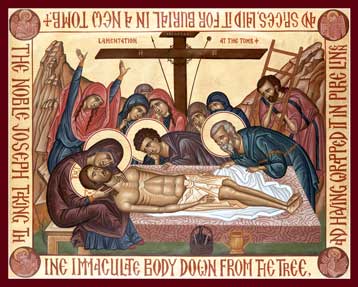
The common thread, then, is the Cross.

“It's all about the Cross”, it appears. But why?

Let me answer by asking you a different question. (Really different!) Your favorite musician these days, whoever it is: how did you get to know them?

You hear a song.

For me, just as an example, it was I Can't Make You Love Me. I heard it on the radio 15 years ago, back in 1991. Had no idea who was singing it; I just knew it affected me, it got to me. It took a while to figure out that it was Bonnie Raitt singing it. So I bought the album it was on, Luck of the Draw. I liked everything on it. So I started buying her older stuff, going back to the beginning, to find out who she was, and what she'd done before.

I didn't meet her “in chronological order.” It started with a powerful encounter in the present: a song on the radio. Only then was there a reason to look back to the beginning. Bonnie Raitt had many albums out before the one with the song I heard. But the history, “the whole story”, as it were, only came later; everything started with what was in front of me, a song on the radio.

It works the very same way with God.

You start with what's in front of you – there is no other way. And what is in front of us is Jesus Christ, crucified and exalted. Listen to how St. Paul delivers the whole gospel message in just a few words:

For I delivered to you first of all that which I also received: that Christ died for our sins according to the Scriptures, and that He was buried, and that He rose again the third day according to the Scriptures, and that He was seen by Cephas, then by the twelve. After that He was seen by over five hundred brethren at once, of whom the greater part remain to the present, but some have fallen asleep. After that He was seen by James, then by all the apostles. Then last of all He was seen by me also, as by one born out of due time. (1 Corinthians 15:3-8, emphasis mine)

Christ died, He was buried, He rose again according to the Scriptures, and He was seen. This is where we meet Christ -- the only place we can meet Christ: on the Cross, dying for our sins, buried, and risen on the third day. There is no other starting point; and there is no need for anything more:

And I, brethren, when I came to you, did not come with excellence of speech or of wisdom declaring to you the testimony of God. For I determined not to know anything among you except Jesus Christ and Him crucified. (1 Corinthians 2:1-2, emphasis mine)

The crucified and exalted Lord is What, or rather, Who we encounter in the Church -- and from that real and powerful encounter, and only from that, can we look backwards, at the "history" of God at work in the world, and forward, to the Kingdom which is to come. Only from that real and powerful encounter can we come to know God.

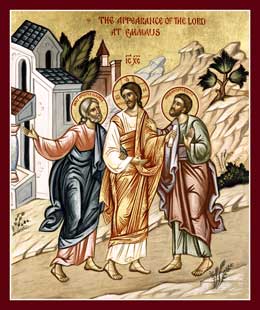
How does this work? Listen to how Luke and Cleopas come to know Christ -- which sounds weird, of course, since they were His disciples and, in theory, had known Him for years:

Now behold, two of them were traveling that same day to a village called Emmaus, which was about seven miles from Jerusalem. And they talked together of all these things which had happened. So it was, while they conversed and reasoned, that Jesus Himself drew near and went with them. But their eyes were restrained, so that they did not know Him. And He said to them, "What kind of conversation is this that you have with one another as you walk and are sad?"
Then the one whose name was Cleopas answered and said to Him, "Are You the only stranger in Jerusalem, and have You not known the things which happened there in these days?"

And He said to them, "What things?"

And they said to Him, "The things concerning Jesus of Nazareth, who was a Prophet mighty in deed and word before God and all the people, and how the chief priests and our rulers delivered Him to be condemned to death, and crucified Him. But we were hoping that it was He who was going to redeem Israel. Indeed, besides all this, today is the third day since these things happened. Yes, and certain women of our company, who arrived at the tomb early, astonished us. When they did not find His body, they came saying that they had also seen a vision of angels who said He was alive. And certain of those who were with us went to the tomb and found it just as the women had said; but Him they did not see.
They did not recognize Jesus in His resurrected body, that much is obvious. But I would argue that, to this point, for all the time they had been with him during His public ministry, Luke and Cleopas did not know him, they had no clue as to who He really was or what He had really done for them. And I'd be right:

Then He said to them, "O foolish ones, and slow of heart to believe in all that the prophets have spoken! Ought not the Christ to have suffered these things and to enter into His glory?" And beginning at Moses and all the Prophets, He expounded to them in all the Scriptures the things concerning Himself. Then they drew near to the village where they were going, and He indicated that He would have gone farther. But they constrained Him, saying, "Abide with us, for it is toward evening, and the day is far spent.
And He went in to stay with them. Now it came to pass, as He sat at the table with them, that He took bread, blessed and broke it, and gave it to them. Then their eyes were opened and they knew Him; and He vanished from their sight. And they said to one another, "Did not our heart burn within us while He talked with us on the road, and while He opened the Scriptures to us?"

So they rose up that very hour and returned to Jerusalem, and found the eleven and those who were with them gathered together, saying, "The Lord is risen indeed, and has appeared to Simon!" And they told about the things that had happened on the road, and how He was known to them in the breaking of bread. (Luke 24:13-35)
He was known to them, eucharistically-speaking, in the breaking of His body. He was known to them only on the Cross.

We, too, start with Jesus Christ and Him crucified, and from this alone, from this powerful encounter, everything else proceeds; in His crucifixion and His exaltation, and in this alone, Jesus Christ is revealed as the Lord, risen indeed. It is the only place to start, and it is the ultimate place to start.

For in bearing His Cross, Jesus totally and completely reveals what it means to be God -- and what it means to say that “God is love.” (1 John 4:8) In other words, the love of God is fully realized and fully revealed when He takes our sins upon Himself and dies for us, He who was completely without sin, and not subject to death Himself. And Jesus Christ is fully realized and fully revealed as God, Who is love, when He rises from the dead.

In fact, it is our faith that the only way to truly know God and to know God's love is by looking at Jesus Christ crucified, which explains why the Jews, God's chosen and covenanted people, who had the Law and the Prophets – that is to say, they had the whole history -- came so close, but then missed something truly essential:
But their minds were hardened. For until this day the same veil remains unlifted in the reading of the Old Testament, because the veil is taken away in Christ. But even to this day, when Moses is read, a veil lies on their heart. Nevertheless when one turns to the Lord, the veil is taken away. (2 Corinthians 3:14-16)
Why was this so hard for them? Why did they completely pass by the full revelation of God and His love when it was right in front of their eyes?
For Jews request a sign, and Greeks seek after wisdom; but we preach Christ crucified, to the Jews a stumbling block and to the Greeks foolishness, but to those who are called, both Jews and Greeks, Christ the power of God and the wisdom of God. (1 Corinthians 1:22-24)
They failed to see, their eyes were veiled, because the Cross was a stumbling block to them. A scandal. An offense.

But not to us. To us the Cross is precious and holy, the treasure of treasures. And we preach Christ crucified, fully realized and fully revealed only when He takes up His Cross: His Cross, which is, therefore, at the center of everything.

And we, as human beings made in His image and likeness, looking upon His Cross, are only fully realized, only fully revealed, when we -- in His image and likeness -- take up our own.

Monday, March 5, 2007

Seems like a bargain to me...

"A major global consulting firm has reviewed Iraq's state-owned enterprises and estimated that it would cost $100 million to restart all of them and employ more than 150,000 Iraqis-$100 million. That's as much money as the American military will spend in Iraq in the next 12 hours."

Read Fareed Zakaria's recent Newsweek column on "The Surge that Might Work". Seems to me that if we left a day early, and used the money we'd save to put 150,000 Iraqis back to work, that would be the very definition of a win-win.

[READ IT]

Saturday, March 3, 2007

Orthodox Question of the Day

QOD: Why do we use so many formal prayers? The Lord's Prayer is the only one that I am aware of that Jesus specifically instructed us on. Why do we even use the "prayers of our holy Fathers" in the first place -- why not just our own personal ones? So many of them sound identical, I kind of imagine God thinking "Can't they come up with anything new?" It just seems so, what is the word I am looking for... "scripted"... not personal. Thanks...

AOD: Great question! Jesus, Himself, warned, "Woe to you, scribes and Pharisees, hypocrites! For you devour widows’ houses, and for a pretense make long prayers. Therefore you will receive greater condemnation." (Matthew 23:14) And think about how He introduces His (the Lord's) prayer:
And when you pray, do not use vain repetitions as the heathen do. For they think that they will be heard for their many words. Therefore do not be like them. For your Father knows the things you have need of before you ask Him. In this manner, therefore, pray: Our Father in heaven, Hallowed be Your name. (etc.) -- St. Matthew 6:7-9
He seems to be warning us precisely against long prayers and repetitions.

But when you look more closely, it's actually hypocritical long prayers made for a pretense, and vain repetitions that He's condemning, not long prayers or repeated prayers themselves. For long prayers, it's hard to beat the "Prayer of Azariah and the Three Young Men" (Daniel 3:24-90, found only in the Greek version of the Old Testament); and for repetitive prayers, Psalm 136 echoes the phrase "For His mercy endures forever!" a total of 26 times. We use both of these prayers liturgically: the former on Holy Saturday (and actually, during every Matins Canon, though you don't usually hear it read), and the latter on the Matins services for feast days, as the "Polyeleos", or hymn of "many mercies". It's actually named (and beloved) for its repetitiveness!

The point of using these prayers -- and other long, complex, and formal prayers -- is, first of all, to take advantage of "best practices". They are magnificent, beautiful, and compelling, and obviously they worked (i.e., God took notice of them), or nobody would have bothered writing them down for posterity! We use these prayers for the same reason that we read classic literature: there is a timeless beauty and value to them such that they survived the Darwinian process of history -- survival of the fittest.

But we also use them to teach us how and for what we should pray. That is precisely the purpose of beginning our services with "The Great Litany", which is a grand survey of all the things we should be including in our own prayers. By putting great examples in front of us in the services, by nourishing us with good and healthy prayers in the public assembly, when we go into our rooms and shut our doors -- as Jesus taught,
But you, when you pray, go into your room, and when you have shut your door, pray to your Father who is in the secret place; and your Father who sees in secret will reward you openly. --St. Matthew 6:6,
we will be able to draw from the treasury of the Church's great prayers to inspire our own. We won't have to wing it.

Of course, there are times when the Spirit fills our hearts and the prayers just come, but this doesn't happen (for most of us) all the time. We need help getting started, and we can draw on so many of the "formal" prayers to put into words what we only wish we could come up with ourselves. It's like a lovesick teenager quoting Shakespeare to his beloved when he finds his own poetry wanting. He may have moments of inspiration, but when the well runs dry, he can always turn to Romeo and Juliet for help.

Like so many aspects of the faith, when you look at "scripted" formal prayers, and our own intensely personal ones, it's not either/or -- it's both/and.

Make sense?

ds